Sunday, 31 May 2015

Out of the Darkness


Hello friends! It's been a long time since I last wrote to you.
A very long time!
There has been archery, of course!
 
I hope you haven't missed me too much! I'm very sorry for the delay, but it's been very hard for me to get my wings on a working computer. In fact, this is the first chance I've had! Let me tell you all about what's been happening.
 
About six weeks ago, Mr. MacInnes and I had just been to a birthday party and it was getting late. I was ready to snuggle down into my nest for the night so we were heading home across the school fields when it started to rain very, very heavily. It was also getting extremely windy, so much so that it nearly blew me back the way we had come! Fortunately we managed to get home quite quickly! I could hear the wind and the rain crashing against my nest for a long time before I fell asleep. When I woke up the next morning the sun was out and the weather was very calm again. However, when I tried to turn on my light it wouldn't come on! And all my worms in the fridge were starting to get warm too. We didn't know it at the time, but the electricity would be gone for two weeks!
 
What had happened was that the storm in the night had been much worse in some other parts of Dagana and had actually blown down some electricity cables! It had also caused a lot of damage to buildings. Some people's roofs had been blown off their houses and some schools had been badly damaged too. We were lucky in Samey because the wind hadn't caused many problems. However, we now had no electricity. This meant that I couldn't use the computer to update my journal, Mr. MacInnes couldn't charge his phone and at night time it was very dark indeed! Have you ever walked around your house at night without any lights on? It can be quite scary! Mr. MacInnes had been sensible and bought lots of candles so we could see a little bit, but I must admit I found it quite difficult to see where I was going! I bumped my beak a lot!
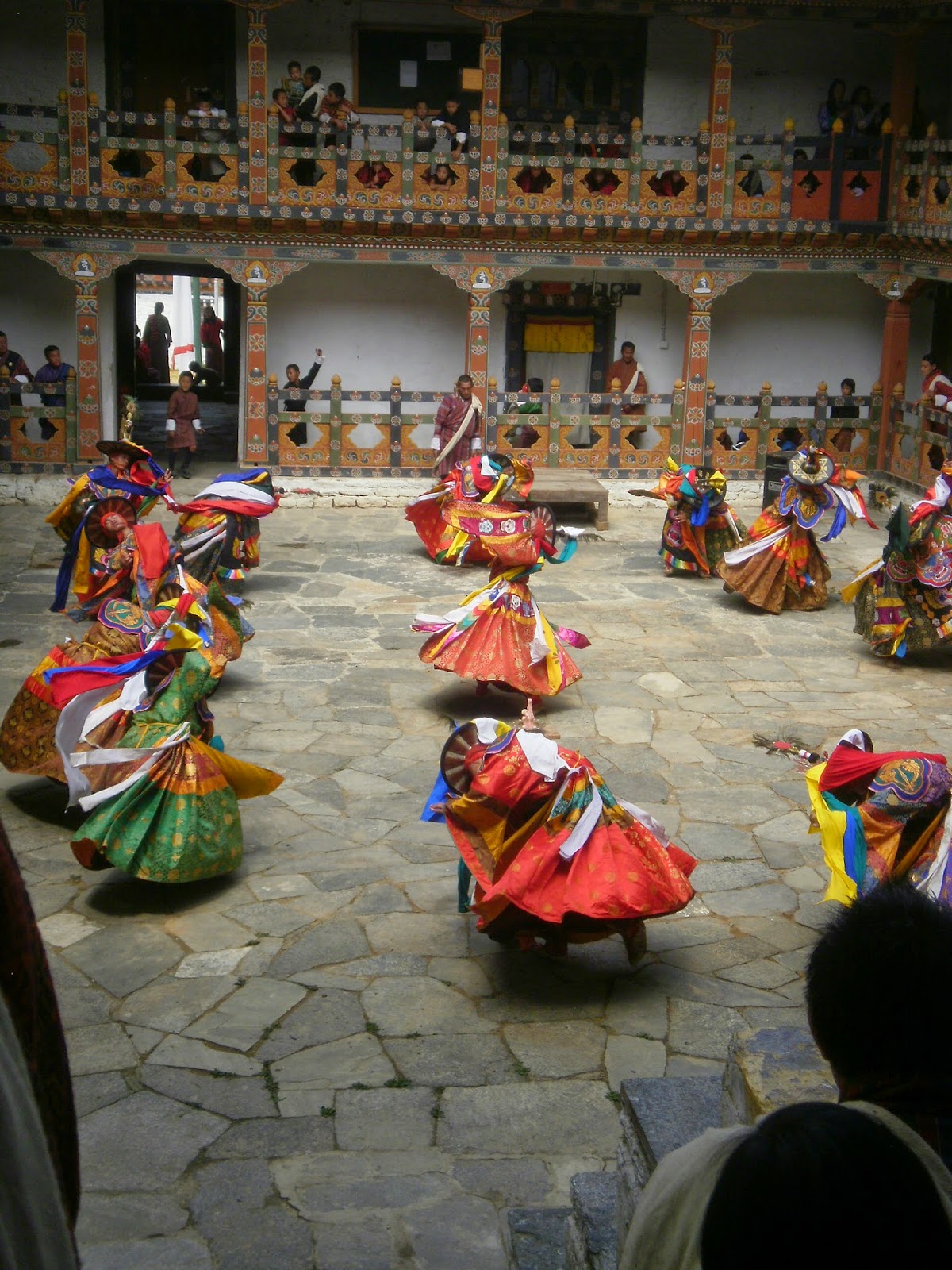
There was also a special ceremony at the school.
 
It was like that for two weeks. But we found lots of things to do to keep busy. Some of our friends invited us for dinner and we played lots of games. I even got time to read my favourite books by candlelight. Cooking and cleaning is difficult in the dark though, and we were very happy when the electricity came back.
But it is important to remember that there are many people in the world, and some here in Bhutan, that don't ever have electricity. We are very lucky in England to be able to turn on a light or plug in a TV whenever we want.
 
I was going to post this blog a bit earlier but then the community centre (the only place where I can use the internet) was closed for a further two weeks as well. But something very important happened recently and I thought I should tell you about it.

On Saturday 25th of April there was an earthquake in this part of the world. If you read my second blog entry you will remember I told you that Bhutan is in the Himalayas, in Asia, and that there is a country nearby called Nepal. It was in this country that the earthquake happened.
Being a bird, I don't know much about earthquakes. But Mr. MacInnes says that they happen when parts of the surface of the earth rub move apart or together. This causes the land to crack or crunch up. 


Although the earthquake was in Nepal, we still felt it here in Bhutan. The chairs in the classroom started wobbling and the fan on the ceiling was shaking. Everyone ran outside into the field and as we looked across the valley you could see trees swaying, even though there was no wind. It was quite scary. What happened next was a bit like when you have a fire drill – we counted all the children and made sure everyone was there and was safe. We had to wait outside in the rain for quite a while, as then can be an aftershock when there is an earthquake. Luckily, nobody (or animal) here in Samey or across Bhutan was hurt and none of the buildings were damaged.

Sadly, many people in Nepal were hurt. In Kathmandu, the capital city, lots of buildings fell down and huge cracks appeared in the roads and in houses. Temples that were hundreds of years old have been destroyed with all the beautiful statues around them, and people's homes were also broken to bits. The worst thing is that enormous numbers of people have died, more than we could even count. It makes me so sad to think of their families and friends. Mr. MacInnes and I were in Kathmandu in January and it is horrible to think some of the things we saw might now be gone forever. We also made many friends there. We think of them every day.
Nepal is a poor country, and that makes it very difficult for the government to help people who have lost their homes and maybe lost their families too. There are many people who need shelter, water and help with trying to find friends. If you think your parents might like to help these people, ask them to visit this charity website.

Children working on cleaning up the community!
I will be back soon to tell you all about how we are getting on at Samey Primary School. Until next time, stay safe and remember to feed my feathered friends in your gardens!

Joe.

Thursday, 2 April 2015

Happiness in Bhutan

Hi friends! It's me again, Joe Crow. I've had a wonderful month of March here in the Kingdom of Bhutan. We celebrated Mr. MacInnes' birthday, went to a special festival at the Dzong (if you want a reminder of what a 'Dzong' is, then visit my first blog) and had a great time getting to know the children at Samey Primary School. Just have a look at the photos!


We had a special reading afternoon at school!


The weather is changing fast – it's not freezing cold at night any longer, and the days are hot. Mr MacInnes is not keen on the little biting flies that keep attacking his legs, though! I wonder what April will bring? 
 
In this entry I'd like to tell you something about “Gross National Happiness”, something that is very important in Bhutan. It is called GNH for short.
 
The four pillars of GNH - painted on our school wall.
In most countries, we look at the economy – how much money the country is making and how much money people have to spend on things – to see how well the country is doing. We also look at whether people have good levels of education, access to hospitals, clean water, electricity, internet and nice things in the shops. This is known as “development”. If a country is doing well in all of those things, we call it a “developed country”. England is a developed country. If some of those things are missing, we sometimes call such a country a “developing country”.

However, in Bhutan, they try to look at more than just the economy and people's living standards when working out how well the country is doing. They also try to measure how happy people are! This is the vision of Gross National Happiness.

A traditional ceremony to celebrate the King's birthday.
 The basic message of GNH is that people's happiness in life is just as important as money, owning nice things and living in a comfortable place. Bhutan believes that in order for people to be happy then development must be sustainable, meaning that things will be as nice for people in the future if not even better than now. Also important is keeping traditions and protecting the environment and all the animals in it.

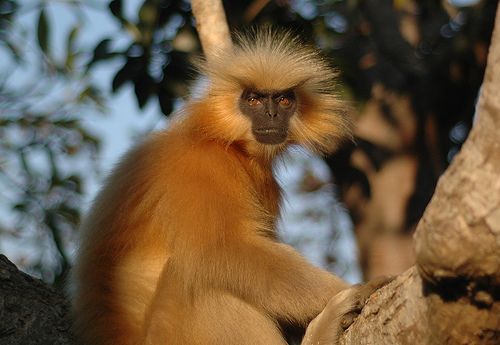
A golden langur.
There are a lot of laws in Bhutan to protect traditional ways of doing things, like wearing the national dress. This means that people won't feel their traditional beliefs will be lost as the world changes. There are also many laws to protect the many rare animals that live in Bhutan, like tigers and rhinos. Most of the country is still covered in forest, meaning that Bhutan is an incredibly special place for animals. There is one species of monkey, the golden langur, that doesn't live anywhere else in the world! Bhutan believes that by keeping these animals – and their natural homes – safe is also important for people's happiness. I love seeing my wild friends healthy and free, don't you?


The fourth King of Bhutan.
The idea of GNH being important in Bhutan's development came from the Fourth King, in 1972. It might be difficult to measure, but Bhutan hopes that other countries and experts will adopt the ideas in their countries too. I really like the ideas of GNH, and I like the way the children learn about the ideas in school too. If these children grow up caring about their world and looking after it, then it will be a better place for animals like me as well as all the people on Earth!


Joe :)

Monday, 16 March 2015

Samey Primary School

I'm sitting in front of the school playing field!

I have now been living in Bhutan for six weeks,

and I’m just about beginning to settle in. I do miss my comfortable nest back home, and all of my feathered family, but I feel very much at home here now. The local birds are friendly and welcoming, and they have done lots to help me get used to my new location.
Breakfast at Samey P.S.
Anyway, a lot has happened since I last blogged. I’d better tell you all about it!

The most important thing is that the children have started a new year at Samey Primary School. In Bhutan, the school year runs from February to December. The children have their long holiday in the winter, when it is very cold!

A normal school day in Samey starts at 7.30 in the morning . Yes, that is very early!!! Some of the children have to walk for an hour to get to school, so that means a VERY EARLY start for them! They do get to have breakfast at school though, and it is very tasty! The breakfast is usually fried rice and chickpeas. Birds aren’t normally allowed to have it, but they make a special exception for me! The food at Samey Primary School is provided by the World Food Programme (WFP). The WFP is a very special organisation that gives food, for free, in places where food might be hard to get or too expensive to buy. The children also get a free school lunch, just like children in England. The lunch is often rice and dhal, which is a lentil soup.


Sitting for breakfast.
 After breakfast is the whole-school assembly. This happens everyday at 8.45, and the children say a special prayer and sing the national anthem. I’m trying hard to learn the words, but the Dzongkha language is very hard to get my beak around! In Bhutan, the children stand up for the assembly. They are very well behaved, and stand very still when listening to the teachers. Lessons begin after assembly. Unlike most primary schools in England, the children at Samey have different teachers for each different lesson. So Mr. MacInnes might teach a class English, and after that a different teacher will teach Science to the same class. There are eight teachers at Samey, and seven lessons a day. So if you were at school here, you might have seven different teachers in the same day!
 
Assembly.


The school day usually ends at 4 o’clock, but sometimes there are sports events in the afternoon too. The children love playing football and volleyball the most! Recently we helped build new football goals for the children, using wood from the forest. It was heavy work, but the children love having proper goalposts now! You can see some of the work we did in the pictures.


Before they go home, the children do social work, where they clean the school and the grounds. Each group of children has a particular area to work in, and they swap throughout the year. Some might sweep the classrooms, while others will look after the vegetable garden and some clean the toilets. Yep, in Bhutan the children clean the toilets!


The side of a classroom. That's the map of Bhutan!
Primary school classes in Bhutan are quite different from in England. Children start school at age 5, and the first class is called Pre-Primary (PP), not Reception. Then, instead of Year 1, the next year is called Class 1. Then Class 2, and so on up to Class 6.
There can be a lot of children in classes in Bhutan. Most classes have about 40 children. But because Samey is only a very small school, there are few children in each class. In Class 5 there are only eleven children, for example.


Samey Primary doesn‘t have much money to spend. So that means there are no SMART Boards, computers or playground equipment like there are in most schools in England. There are lots of other resources you will know though, like multilink cubes, base-10, and wall displays. There is also a blackboard instead of a whiteboard. You have to use chalk to write on those instead of pen. The children bring their own writing books to school everyday. They can be heavy, but at least they can always show their Mum and Dads what they have been doing each day!


Mr. MacInnes says he finds the classes a lot quieter than the ones he’s had in England, which can make it difficult when he wants them to do group work! However, they are beginning to talk a bit more now that they feel less shy. And they love seeing me! I have really enjoyed helping Class 1 learn English. I have had to pretend to be a bit naughty so they could learn how to say “excuse me” and “I am sorry”! They are getting better everyday.


I hope you’ve learned a bit about school life in Samey. If you have any questions, please put them in the comments below or ask a grown up to help you. I hope you enjoy the pictures!
Joe :-)


Thursday, 26 February 2015

Life in Samey

Hi friends, thanks for stopping by! 


If you’re new to my blog, my name’s Joe Crow and - you guessed it - I’m a crow! I’m originally from Britain but now I’m living in the Kingdom of Bhutan. If you would like to know more about me or Bhutan then please read my previous blog entries.

Our home in Samey.
The view from outside our house!

I’m not living here on my own though; I’m living with my good friend, Mr. MacInnes. He’s a human being unfortunately, but despite that he’s not too bad to live with. Besides, he can help me type my blogs because he has actually got fingers! He’s the real reason I’m here, because he’s a primary school teacher and he decided he wanted to go and teach in Bhutan. Well, I couldn’t let him go all by himself could I?!

When Mr. MacInnes applied to teach in Bhutan, we had no idea of where in the country we would end up. It was up to the Royal Government of Bhutan, and an organisation called the Bhutan Canada Foundation (BCF), which school would most like to have us. [If grown-ups would like to know more about BCF then please click here]. They decided we would be best in Samey Primary School. Samey is pronounced ‘Sammy’. It’s a very small school, and there are only 103 children in seven classes. Mr MacInnes will be teaching English to children in four of the classes.

Samey Primary School is in a little village, also called Samey, which is in the Dagana district of Bhutan. Can you find Dagana on the map?

Our home!
The road to Samey.
We went to a party!
Me outside our home.

This is the reception classroom (called PP here)!
Children playing outside the hall.
We’ve now been living in Samey for two weeks! It was quite exciting moving here, as I am the first ever yellow-beaked crow to live in Dagana. Also, Mr. MacInnes is the first ever person to live in Dagana who isn‘t from Bhutan. Because we look a bit different, lots of people (and birds!) have been interested in learning about us and where we are from. Although we are different, everyone has been very kind and welcomed us in to their communities and homes. We’ve been invited to lots of parties and dinners, and even to watch special archery matches!

Mr. MacInnes and I live in the school grounds, which makes it nice and easy to get to work in the morning! We live next door to another teacher, and very close to the headteacher too. I bet most of your teachers have to drive their cars to school each morning! Well all of the teachers here live very close indeed!

Samey is at the top of a steep hill, and there are only a few houses. The only way to get here is by a farm road, not the kind of road you will be used to. It takes quite a long time to drive up it because it is very rocky and muddy. I can fly up and down very easily but Mr. MacInnes gets tired legs from walking! There is a small town at the bottom of the hill, where Mr. MacInnes can buy some food. The shops are all very small, and there are no Tescos or Sainsbury’s or any other supermarket here! So many of the things you might buy are not available in Dagana. Mr. MacInnes says he misses pizza and humous the most!

The favourite foods by far here in Dagana are rice, cheese and chillies. Yes, chillies - the spicier the better! Some of the food is so spicy it burns my beak! But I’m slowly getting used to it. The most popular dish is called ema datsi. That’s chillies (usually halved, but sometimes whole) in a cheese sauce. Yowch! I’ll stick to what I can find on the ground thanks! But Mr. MacInnes seems to enjoy it. He’s crazy!

It’s so very quiet and peaceful here, and there’s lots of time to read my favourite books and go for a flap in the beautiful countryside. Mr. MacInnes got all excited because he went walking and saw a type of eagle called a Steppe Eagle. Hmmph! Crows are much more interesting! They’re waaaay cleverer too!!! Sometimes the peace and quiet gets interrupted by the shouts and cries from excited archers or noisy dogs. There are lots of stray dogs in Bhutan but most of them are friendly. However they do keep me up at night with their barking sometimes! If you do go walking in Bhutan it’s very common for people to invite you into their house for a cup of tea as you walk past. People like to show kindness to each other here and often if you say “no thank you” to something offered to you, people will keep insisting until you say yes!

I hope you can get an idea what my home in Bhutan is like from the pictures. Until next time, goodbye and Tashi Delek!

Joe :)

Tuesday, 17 February 2015

What is Buddhism?

Hey feathered friends (and a big hello to the ones without feathers too)!
Visiting a Buddhist temple.

     
Do you remember that last time I was telling you about how most people in Bhutan are Buddhists? “Buddhist” might be a new word for some of you. I know my crow pals back in England won’t have heard it before. But then again, most of them can’t speak English as well as I can! 
(PS - did you know a group of crows is called a ‘murder’? It’s true!!! I often hang out in a murder of crows!)


A painting of the Buddha.

I thought with this blog update I’d try to explain a bit more about what Buddhism is and what Buddhists believe, so here we go!
It all starts with a man known as ‘the Buddha’. He lived over 2,500 years ago and was born in an area near the border between India and Nepal. You can find out where those countries are by looking at the map in my last blog post. They are very near to Bhutan!
Another painting of the Buddha.

The Buddha’s real name was Prince Siddharta Gautama. Yes, he was a real prince! Because he was a prince he had everything he could want - money, good food, lots of nice possessions and a powerful family. But one day, the young prince snuck out of the palace to have a look at the places around him. He soon noticed that not everyone was as lucky as him. He saw sick, old and dying people, and he realised that all of the nice things he had couldn’t help save people from the problems of the world. As he grew up, the prince decided to leave behind his royal life to search for the true way to help people escape from suffering. One day, he sat under a tree and entered into a deep meditation* in which he was able to develop complete peace in his mind. For the rest of his life he taught people how to develop this peace, and about how caring for and loving others brought true happiness.

Some Buddhists are visiting a temple. One of the ladies is spinning prayer wheels.
Throughout the many years since his death, people have read, studied and followed the Buddha’s teachings. These people are called Buddhists. They aim to not only reach total peace and happiness (a state called nirvana), but to help all other living beings reach this happiness too. The main focus for a Buddhist is to develop love and compassion* for all living beings. This is known as Buddhism.

Many Buddhists believe that when you die your spirit lives on, and comes back to live another life. Maybe I’ll get a chance to be inside an egg again! However, the goal of Buddhism is to escape from the cycle of rebirth and suffering that everyone goes through, and to reach nirvana.

The Wheel of Life. This picture shows all the different ways you could be reborn.
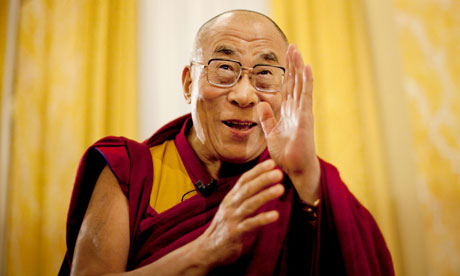
The Dalai Lama [Image from The Guardian]
There are different kinds of Buddhism in the world, and the type practised in Bhutan originally comes from Tibet. This is a country on the northern border of Bhutan (have a look at the map again!). The Dalai Lama is the most famous Tibetan Buddhist in the world. He is a very special man; even some of my crow friends have heard of him! He is a good friend to children, and has written many books on how to be happier and have more compassion.

In Bhutan you can see many pictures and statues of the Buddha. Tibetan Buddhism uses a lot of colourful paintings, pictures and statues to help people in their meditations. You might often see people bowing down in front of statues of the Buddha or other important figures. However, they are not worshipping them like a god, but showing respect and thankfulness for the Buddha’s teachings.
Many homes have statues to help remind people about the Buddha's teachings.

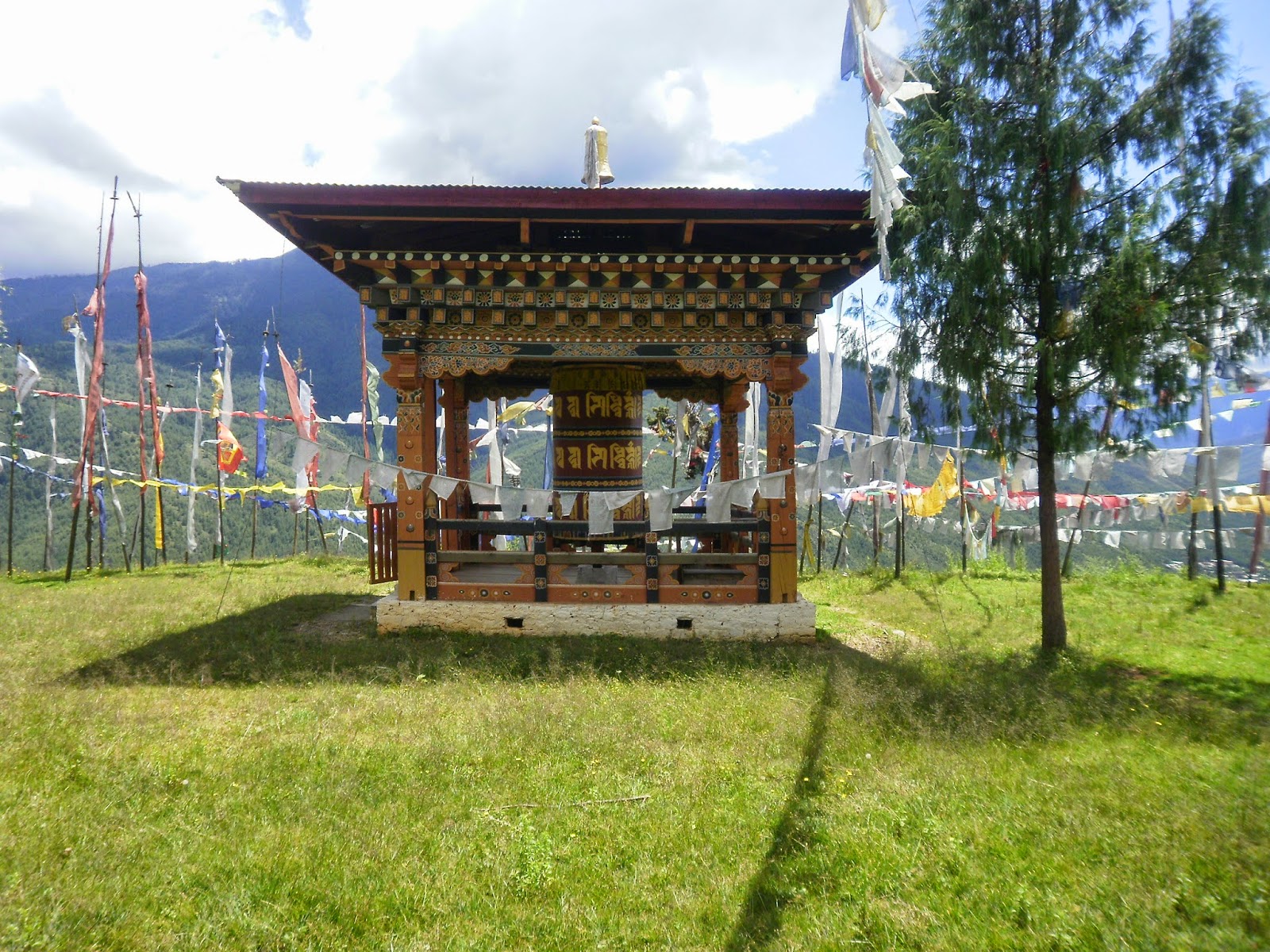
These are prayer wheels

When spun around, the wheels help people eliminate bad thoughts and concentrate on positive thoughts and wisdom. Some of the prayer wheels have a beautiful bell attached to them that rings out very loudly. I have to fly round them very fast to get them to move, but you must always do it clockwise!


Another prayer wheel. In the background are lots of prayer flags.

Can you see the big building behind me?
 

These kinds of buildings are called chortens in Bhutan. These are also called stupas. They often have Buddhist relics inside them, like the ashes of respected monks. The one in the picture is a very, very big one, but most are quite small. Buddhists often visit them as places of meditation, and to concentrate on developing compassion. They are often in very peaceful places, and are lovely to fly around and think about the world (but I always fly clockwise around them!). Buddhists believe it is very good for you to build stupas.


I hope you've learned something new about Buddhism! If you have a question for me, please write it in the comments below. I'll do my best to get back to you as quickly as I can (but I find it very hard to type without fingers)!

This is the big chorten. It's called the National Memorial Chorten.
A smaller chorten.

*Meditation - Spending time in very deep and quiet thought. 
*Compassion - Showing kindness and caring, and being willing to help others.
*Relic - An old object, usually belonging to someone or something very important.